Showing posts with label Myanmar. Show all posts

Sunday, October 14, 2007

Blood, Robes And Tears: A Rangoon Diary

Thursday, Oct. 11, 2007

Blood, Robes And Tears: A Rangoon Diary

By Andrew Marshall

This is a TIMES article.


Photograph for TIME by James Nachtwey�VII


You should get closer," says the young Burmese woman in the crowd behind me. "If foreigners are there they won't shoot." She is terribly wrong.

It's about 1 p.m. on Sept. 27, and I am wedged among thousands of pro-democracy protesters near the golden-domed Sule Pagoda in downtown Rangoon. Facing us are hundreds of soldiers and riot police, who look on edge as they finger their assault rifles. The protesters, mostly ordinary Burmese clad in sarongs and sandals, appear undaunted, even jubilant. Defiantly, they chant a Buddhist mantra whose melody will haunt me for days:

Let everyone be free from harm.
Let everyone be free from anger.
Let everyone be free from hardship.

Originally uploaded by Jamzer

The Buddhist monks first sang this mantra. For a week now, they had been marching, calling peacefully for change in a country ruled for almost half a century by a corrupt and barbaric junta. Burma's monkhood and military are roughly the same size — both have between 300,000 and 400,000 men — but the similarities end there. With the monks preaching tolerance and peace, and the military demanding obedience at gunpoint, these protests pitted Burma's most beloved institution against its most reviled.

"Get closer," the young woman urges, but a hundred yards away feels close enough. Last night, soldiers like these had raided monasteries, beating and arresting hundreds of monks. Soldiers like these had also snuffed out Burma's last great pro-democracy uprising in 1988 by killing and injuring thousands. I know they will not hesitate to shoot.

Sure enough, seconds later, they open fire. But until that moment — until the moment this jubilant crowd scatters in anger and fear — millions of Burmese had glimpsed what life was like without their hated rulers. That glimpse might yet undo a junta, which today faces unprecedented pressure from its long-suffering people, from other nations, and perhaps even from within its own military ranks. Are the protests that took place over 10 days in late September over, or merely dormant?

I am a Briton who first fell in love with Burma a decade ago, bewitched by its rich culture, breathtaking landscapes and hospitable people. Despite their isolation and the ever-present fear of arrest, I found Burmese to be worldly and eager to talk; I quickly formed lasting friendships, and Burma became the subject of my second book, The Trouser People. I returned perhaps a dozen times, witnessing changes that were usually for the worse. People grew poorer, stalked by disease and malnutrition. Inflation lurched ever upwards. Schools and hospitals crumbled with neglect. Insurgencies raged along the rugged borders. The brightest Burmese sought lives abroad. The only real constant was the junta, which had seized power in 1962 and run a promising nation into the ground.

Originally uploaded by Jamzer

But there were positive changes, too. The 2004 purge of military intelligence chief Khin Nyunt dealt a blow to a once fearsome spy network. Then, one year later, the regime moved to its remote new capital at Naypyidaw. Suddenly, people in Rangoon seemed to talk a little more freely. Mobile phones and the Internet arrived and, despite being costly and state-controlled, were embraced by thousands. Student activists jailed after the 1988 protests were released and regrouping as an alternative to the National League for Democracy (NLD), the beleaguered party of Nobel laureate Aung San Suu Kyi, who has spent 12 of the past 18 years under house arrest.

It was members of this self-styled '88 generation who hit the streets in August to protest the government's fuel-price rises. The protests were quickly snuffed out, or so it seemed. Three weeks later, I arrived to witness what now seems like a dream: a first vision of the marching monks.

SUNDAY, SEPT. 23

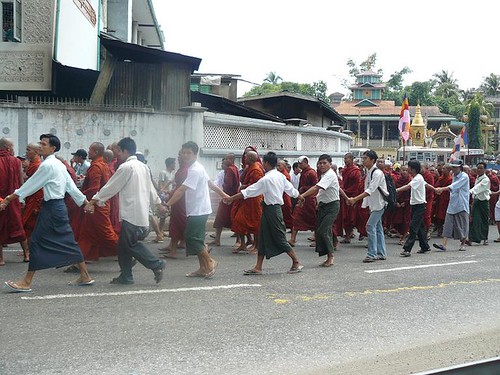
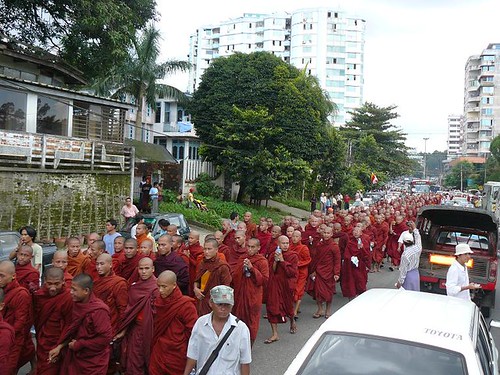
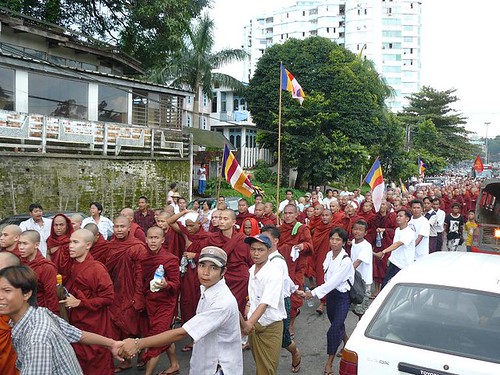
They pour south from the Shwedagon, the immense golden pagoda that is Burma's most revered Buddhist monument, in an unbroken, mile-long column — barefoot, chanting, clutching pictures of Buddha, their robes drenched with the late-monsoon rains. They walk briskly — if you stick to the city's crumbling pavements it is almost impossible to keep pace with them — but when they reach Sule Pagoda they stop awhile to pray. Soon they're off again, coursing through the city streets in a solid stream of red and orange, like blood vessels giving life to an oxygen-starved body.

Their effect on Rangoon's residents is electrifying. At first, only a few applaud. Others clasp their hands together in respectful prayer, or quietly weep. One man, watching the procession without apparent emotion, abruptly folds away his umbrella so that his hands are free to applaud, and the falling rain obscures his tears. I ask another onlooker, an elderly teacher, how he feels. Overcome, he presses a clenched fist to his heart and croaks, "Happy." The monks will soon be joined by tens of thousands of Burmese, some chanting their own mantra, in English: "Democracy! Democracy!"

Originally uploaded by Jamzer

MONDAY, SEPT. 24

A Burmese reporter takes me to meet some monks at a pagoda in the Shwedagon's shadow, a rallying point for the daily marches. It must be under government surveillance. So, surely, is the tall figure in a white shirt and dark sarong who greets me — the poet Aung Way, another '88 stalwart, jailed three times for his political views. He presses a poem into my hand, which I nervously shove into my pocket and forget about.

Some monks chew betel-nut, which makes their mouths froth alarmingly with blood-red saliva. The oldest monk, who is 49 and from near Mandalay, is holding a Burmese translation of Francis Fukuyama's The Great Disruption. He is articulate and resolute. "We have three demands," he tells me. "Release Aung San Suu Kyi and all other political prisoners. Begin a process of national reconciliation. Lower the prices of daily commodities." China and Russia must withdraw their support for the junta, he continues, while the U.N. Security Council must discourage it from using violence.

Yet violence is what they expect. "Next they will use tear gas and water cannon," predicts another monk. "Then they will beat and arrest people. We are not afraid." A third monk, 23 years old, comes from Natmauk, the birthplace of Aung San, the father of Suu Kyi, a man whose obstinate sense of purpose won Burma's independence from Britain. "We mustn't retreat," the monk says. "If we retreat now, we fail."

In the evening Brigadier General Thura Myint Maung, Minister of Religious Affairs, appears on state television and threatens unspecified "action" against the monks. Within hours, trucks with loudspeakers are cruising Rangoon's dimly lit streets, announcing a curfew and threatening to arrest anyone who marches with the monks. The junta is making its move.

Originally uploaded by Jamzer

TUESDAY, SEPT. 25

So it begins. Many democracy figures are arrested overnight. The poet Aung Way is in hiding. Guiltily, I pull his poem from my pocket and read it for the first time. "We want freedom," it reads in part. "We want friendship between our army and our people." The army isn't interested. The New Light of Myanmar, the junta's barely literate newspaper, blames the violence on "hot-blooded monks" who are "jealous of national development and stability."

Still they march. The demonstrations are now so large that downtown Rangoon has a carnival atmosphere. Applause rains down from balconies overlooking the route. One monk holds aloft an upturned alms bowl, symbolizing his refusal to accept offerings from military families, a potent gesture in a devoutly Buddhist country. Students join the march, waving red flags bearing a fighting peacock — once an anticolonial emblem, but since 1962 an anti-junta one. At the rear of the column, the chants shift up a few octaves — it's a group of shaven-headed Buddhist nuns in their bubble-gum-pink robes.

WEDNESDAY, SEPT. 26

The eastern gate of the Shwedagon is where thousands of monks usually exit to start their march into downtown Rangoon. But today the gate is locked and guarded by soldiers and riot police. They are confronted by hundreds of angry monks and students. It is a little after noon, and the battle for Shwedagon is about to begin.

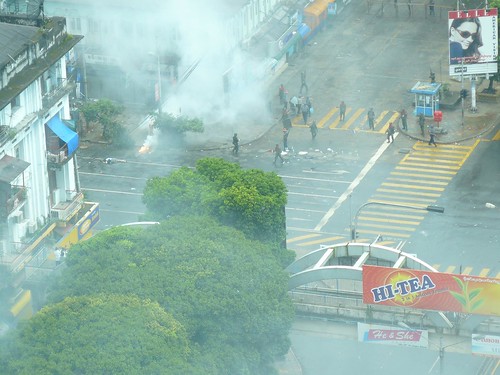
There are explosions — smoke bombs, meant to shock and disorient — and the riot police charge, striking the protesters with canes. The monks and students fight back, and soon there is the unmistakable crackle of live ammunition — the soldiers are shooting above our heads. The monks dress their wounds and begin their march downtown. Trucks full of soldiers pursue them, watched from the pavement by eerily silent crowds. Near Sule Pagoda, trucks are jeered and pelted with rocks, and the soldiers again open fire over the protesters' heads. But as dusk approaches, the crowds disperse. The shops have been shuttered all afternoon, and the pavement teashops for which Rangoon is famous vanish. Nobody wants to be out on the streets after dark.

Originally uploaded by Jamzer

THURSDAY, SEPT. 27

During last night's curfew, troops surge into monasteries across the city, beating and arresting monks. At Ngwe Kyar Yan, a monastery famed for its leadership role in the 1988 uprising, the floors are puddled with blood and the thin dormitory walls perforated with what Burmese call "rubber bullets." They are actually ball-bearings with a thin rubber coating, shot from a 40-mm cartridge. A direct hit at close range can take out eyes, crack skulls, stop hearts.

The raids enrage the people. The lives of Burmese Buddhists are intertwined with the lives of the monks. Monks preside over marriages, chant over the dead; they shelter orphans, care for the sick; and they rely upon the people for food, medicine, clothes and shelter. "A devout Buddhist will not even step on the shadow of a monk," says a Rangoon resident. "When a monk approaches, we move aside to let him pass." And so, with soldiers and police still inside Ngwe Kyar Yan, hundreds of local people surround it. "We had no weapons and knew we couldn't compete with the military," a neighbor tells me. "Everyone just wanted to protect the monks." Eventually, with night approaching, the security forces fight their way out with live rounds, killing two people.

"You should get closer." And so I find myself in a crowd near the Sule Pagoda, facing soldiers and riot police. Only a handful of monks have escaped the junta's dragnet to join this protest. When more trucks pull up at the intersection, and the troops inside noisily cock their rifles, the crowd tenses as one. Seconds later, there are explosions — more smoke bombs — and we are running for our lives.

We run along the pavements, keeping low, chased by the sound of gunfire and more explosions. The nearest escape route is 33rd Street, narrow like so many in the downtown area, and it is a seething bottleneck of people — sitting ducks — so I run on and dart up 34th Street. Are they firing over our heads? Not all the time. Not far from where I had been standing lies the body of Japanese cameraman Kenji Nagai, shot dead by a soldier at point-blank range.

People say the troops used tear gas. They didn't, because I never feel its sting in my eyes. But there are tears, nonetheless. I meet an old man, a retired engineer, choked with emotion. I asked him if he had joined the protests. "No," he replies. "I am too old now to run from bullets." At that moment, more military trucks race past; one soldier trains his rifle on the crowds, and scowls. "Quick, we must go," says the old man. "They are going to start shooting us."

Riot police are marching north up Sule Pagoda Road, banging their truncheons against their shields. An even more menacing sight is behind: hundreds of troops, marching in formation, sealing off downtown Rangoon. Between the riot police and the troops are trucks with loudspeakers making announcements to clear the streets. For more than a week — for most of their lifetimes — Burmese have called peacefully for dialogue. This is the closest the junta gets to it: screaming at its people through loudspeakers from a truck surrounded by men with guns.

I can still hear gunfire at 5 p.m. — continuous, loud, high caliber, some of it very close, most of it caroming through the streets from the east. I phone a Burmese friend who lives in the area. He is holed up in his house with his wife and three children. "What's happening?" I ask. He replies: "They are hunting us."

Originally uploaded by Jamzer

FRIDAY, SEPT. 28

The New Light of Myanmar gives its version of yesterday's events. "Groups of demonstrators in Yangon mobbed the security forces, throwing stones and sticks at them, using catapults and swords," it reads. "The security forces had to fire warning shots." The official toll is 10 dead, including Nagai. But everyone believes the real death toll is much higher. A U.N. official tells me 40 were killed and 3,000 arrested, including 1,000 monks. Another diplomat hazards "hundreds" of deaths.

The crackdown — the killings and beatings, the thousands of arrests — seems to have worked. The protests today are small and sporadic; one in the downtown area is defused by troops firing more "rubber bullets" down Anawratha Street. There are no more marches: their rallying points, the Shwedagon and Sule pagodas, are locked and guarded. A hundred or so people are jeering at soldiers on Pansodan Street. I watch the soldiers strike a youth over the head, before pushing him into a truck. "A schoolboy," remarks another onlooker angrily.

The 2007 democracy uprising feels over. Even the monsoon rains — such a feature of these once joyous protests, with the monks marching shin-deep through flooded streets — have petered out. The sun returns and a cheerless rainbow arcs across the skyline. "Peace and stability restored, traveling and marketing back to normal in Yangon," trumpets the New Light of Myanmar.

But the junta's victory could prove Pyrrhic. Buddhism matters in Burma. The regime has spent years cultivating its image as the religion's protector. That image is now shattered. The generals' assault on a revered institution might yet cause cracks in the army's ranks. "Soldiers are humans," says a Burmese analyst in Rangoon with close ties to the military. "They have families. They have monks among their relatives." And, like Burmese everywhere, they are listening to horror stories. One teenager was stripped, beaten and interrogated by troops in a windowless building, where the floor doubled as a latrine. "Some monks told the soldiers they would go to hell one day," he told AFP. "The soldiers cried, because they knew this was true."

The prospect of eternal damnation is not the army's only problem. It is crippled by low recruitment and high desertion rates. "It's under strength," says the Burmese military analyst. "Most regiments have fewer than 200 men. Nobody wants to join the army anymore." I saw many troops in Rangoon ill-equipped with rusting rifles. The soldier who killed Nagai was wearing flip-flops.

The economic misery that sparked the protests, moreover, remains unaddressed. "People have been successfully intimidated into keeping their heads down — maybe," says Shari Villarosa, chargé d'affaires at the U.S. embassy in Rangoon. "But it's still a struggle for them to survive. So there could be another eruption. I wouldn't be surprised."

If that happens, what can the world do? There is already intense international pressure, although its impact on this xenophobic regime is questionable. Over four days in Burma, U.N. special envoy Ibrahim Gambari met both Suu Kyi (twice) and junta chief Than Shwe, but his efforts look unlikely to kick-start a dialogue between the two. Similarly, China's influence over Burma — and its willingness to use it — is probably exaggerated. A Western diplomat in Rangoon says Beijing would like to see Burma make a "managed transition" — not to democracy, but to "something with a more stable base of popular support." But China's U.N. ambassador, Wang Guangya, recently characterized Burma's troubles as "basically internal."

Originally uploaded by Jamzer

For millions of people worldwide — from college students to America's First Lady — Burma is more than a country. It is a heartfelt cause. So far, however, it is a failed one, mired in a well-intentioned but self-defeating obsession with sanctions that barely dent the finances of the generals. Meanwhile, Burma has a grave and worsening humanitarian crisis: half of all Asia's malaria deaths occur here; a third of children under 5 years old are malnourished; most of its people live on less than a dollar a day. Yet Burma receives less humanitarian aid than almost every other poor country.

The U.S. government is calling for "meaningful dialogue" with all the democratic groups in Burma. So are the usually quiescent members of the Association of Southeast Asian Nations. Will any of this make a difference? "In 1988, Burma wasn't part of ASEAN, it wasn't in the international spotlight, and the effects of globalization weren't so obvious," says the military analyst. "Maybe I'm too optimistic, but I feel this time the generals have to address the situation in some way."

Burma is often described as an isolated country. Yet it's not the people who are isolated — witness, for example, how skillfully they used the Internet to globalize their protests — but the generals. The world's challenge is finding ways to break that isolation and convince Burma's rulers to listen to its people. Before leaving Rangoon I met a former political prisoner who was delighted to see so many young students in the recent protests. "Some were carrying fighting peacock flags, just like in '88," he said. "The message has clearly got through to the next generation." The junta's troubles aren't finished yet. Nor are Burma's irrepressible democrats.


Tuesday, October 2, 2007

We're Approaching 500,000!


Uploaded by cn.momo


Wow! The growth has just been phenomenal. Just a few days ago, we just broke 100,000 and the figure at this very moment stands at 456,000 and will exceed the 1/2 million figure before dawn. People really feels strongly about this issue. Looks like the million figure mark is really within reach. Let us give it the last push!!


I'll now be returning to my regular posting for this blog after this. There are a lot of others who can do a much better job than me. One place where you can get tons of information is "Support the Monks' protest in Burma" group in Facebook -
http://www.facebook.com/group.php?gid=24957770200&ref=mf
Those that wanted to do more or to just keep abreast of what is happening in Myanmar will find a lot of suggestions in this site. There are more bad news like the one about thousands of protesters being executed in Burma. This is really a very brutal regime.


I'll continue to help readers track the petition until it reached 1 million. Thank you everyone for being with me in this and thank you my readers for your patience.


Monday, October 1, 2007

We have achieved 310,000!


Burma's generals have brought their brutal iron hand down on peaceful monks and protesters -- but in response, a massive global outcry is gathering pace. The roar of global public opinion is being heard in hundreds of protests outside Chinese and Burmese embassies, people round the world wearing the monks' color red, and on the internet-- where our petition has exploded to over 200,000 signers in just 72 hours.


People power can win this. Burma's powerful sponsor China can halt the crackdown, if it believes that its international reputation and the 2008 Olympics in Beijing depend on it. To convince the Chinese government and other key countries, Avaaz is launching a major global and Asian ad campaign on Wednesday, including full page ads in the Financial Times and other newspapers, that will deliver our message and the number of signers. We need 1 million voices to be the global roar that will get China's attention. If every one of us forwards this email to just 20 friends, we'll reach our target in the next 72 hours. Please sign the petition at the link below -if you haven't already- and forward this email to everyone you care about:


http://www.avaaz.org/en/stand_with_burma/t.php


The pressure is working - already, there are signs of splits in the Burmese Army, as some soldiers refuse to attack their own people. The brutal top General, Than Shwe, has reportedly moved his family out of the country – he must fear his rule may crumble.


The Burmese people are showing incredible courage in the face of horror. We're broadcasting updates on our effort over the radio into Burma itself – telling the people that growing numbers of us stand with them. Let's do everything we can to help them – we have hours, not days, to do it. Please sign the petition and forward this email to at least 20 friends right now. Scroll down our petition page for details of times and events to join in the massive wave of demonstrations happening around the world at Burmese and Chinese embassies.


With hope and determination,


Ricken, Paul, Pascal, Graziela, Galit, Ben, Milena and the whole Avaaz Team


Dear Readers, we have done well! The figure is now 310,000! Let us redouble our effort and try to achieve 1 million strong!


Myanmar protesters offer prayers outside the Myanmar's embassy during a demonstration in Kuala Lumpur, Malaysia, Friday, Sept. 28, 2007. More than 2,000 Myanmar immigrants rallied peacefully outside their country's embassy in Malaysia, chanting slogans of support for Buddhist monks and other pro-democracy demonstrators in the military-ruled nation. (AP Photo/Lai Seng Sin)

All photos are contributed by: cn.momo


Saturday, September 29, 2007

Japanese Photojournalist 'deliberately shot'.


I just came across this shocking report in The Home of Attila


It contained a link to a YouTube video showing Japanese photojournalist being deliberately killed by Burmese troops.


http://www.youtube.com/watch?v=BUUQi1ooEAs

September 29, 2007

Video shows Japanese journalist Kenji Nagai ‘being shot deliberately’


Filed under: BurmaAtilla89 @ 7:16 pm


I’m sure that many of you have been watching the situation in Burma very closely. Once again I really hope these protesters are successful and overthrow the military. Anyway, here’s the shocking video of Japanese journalist, Kenji Nagai being deliberately shot through the heart. This video does contain disturbing scenes.


Here is more on the subject from the UK Times.


Footage capturing the last, terrible seconds of Kenji Nagai’s life has been aired on Japanese television – horrifying a nation and raising official suspicion that the 50-year old photo-journalist was murdered by Burmese troops (writes Leo Lewis in Tokyo).


The shaky, indistinct moments of footage appear to show Nagai, who was on the edge of a crowd of panic-stricken demonstrators, shoved violently to the ground by a soldier and shot dead at point-blank range.


The crowd flees, leaving behind a visibly agonised figure believed to be Nagai – dressed casually in shorts and flip-flops – on his back in the street. In his right hand is a video camera, held above the ground to protect it from the fall.


A loud crack is audible as a soldier points his rifle at the prone figure before launching himself at the dispersing crowd of protesters.


A doctor at the Japanese embassy in Burma confirmed a bullet entered Nagai’s body from the lower right side of his chest, pierced his heart and exited from his back.


The footage, say Japanese experts, squarely contradicts the official Burmese explanation of Nagai’s death – that he was killed by a “stray bullet”.


In the few seconds before he was killed, Nagai appeared to being filming the Burmese military as it faced down the crowd. One of the soldiers seems to spot him doing so, and launches his deadly response.


The Unsung Heroes.


I apologized to my regular readers for deviating from what I usually write for this blog but I know you will all understand and support me. Sometimes, there comes into our life a cause that is much bigger than any of us and an urgency that demand our immediate and complete attention. We cannot stand aside and watch it go by without doing anything. Here we are presented with a chance to do something from wherever we are. We must grasp it.


We have no idea if what we do will make any impact but that is no excuse for not taking action. The least we can do is to provide some solace to the poor people of Myanmar that there are hundreds of thousands of people all over the world who feels their anger and their pain. And that - cannot be wasted effort.


Sorry if I offend anyone by saying - if you just sign up, you've not done enough. Please help to spread the words. Parents, share it your children. Teachers, share it with your students. Clubs, share it with your members. Friends, colleagues and lovers, share it with your close ones. Shout it out in MySpace, Friendster, Facebook, or wherever you congregate. Link it back to my blog or start your own links. Let us together try to make a difference. If we fail, it shall not be for lack of trying.


Yesterday, the tally stood at 173,000+. At this hour the new figure is 215,000+ nearing the targeted 250,000. But why stopped there? With all your help, let us go the distance - one million caring individuals of the world demanding an end to the atrocities happening in Burma. Use whatever imagination and ingenuity that you may have to get people to add on to the petition. Let our voice be heard - loud and clear.


I'm very happy to note a sudden spike in new readers yesterday after I posted the information on Avaaz in Flickr. I assumed you are all here to lend support to the Myanmese cause. Let us do more.


For my readers, old and new. I've selected a few quotations from Aung Sang Suu Kyi which proved not only to be insightful but prophetic. If you've any difficulty remembering her name, I liked the memory aid used by Jim Carrey "And let's face it: the name's a little difficult to remember. Here's how I did it: Aung San sounds a lot like 'unsung,' as in unsung hero. Aung San Suu Kyi is truly an unsung hero." The people of Myanmar are also unsung heroes. Let us change that - let us sing their praise.


Ghostwise shall refrain from making any comments out of respect and not wanting to trivialize the gravity of the situation:


It is not power that corrupts but fear. Fear of losing power corrupts those who wield it and fear of the scourge of power corrupts those who are subject to it.


Fearlessness may be a gift but perhaps more precious is the courage acquired through endeavour, courage that comes from cultivating the habit of refusing to let fear dictate one's actions, courage that could be described as "grace under pressure" — grace which is renewed repeatedly in the face of harsh, unremitting pressure.


Within a system which denies the existence of basic human rights, fear tends to be the order of the day. Fear of imprisonment, fear of torture, fear of death, fear of losing friends, family, property or means of livelihood, fear of poverty, fear of isolation, fear of failure. A most insidious form of fear is that which masquerades as common sense or even wisdom, condemning as foolish, reckless, insignificant or futile the small, daily acts of courage which help to preserve man's self-respect and inherent human dignity. It is not easy for a people conditioned by fear under the iron rule of the principle that might is right to free themselves from the enervating miasma of fear. Yet even under the most crushing state machinery courage rises up again and again, for fear is not the natural state of civilized man.


We have faith in the power to change what needs to be changed but we are under no illusion that the transition from dictatorship to liberal democracy will be easy, or that democratic government will mean the end of all our problems. We know that our greatest challenges lie ahead of us and that our struggle to establish a stable, democratic society will continue beyond our own life span. But we know that we are not alone. The cause of liberty and justice finds sympathetic responses around the world. Thinking and feeling people everywhere, regardless of color or creed, understand the deeply rooted human need for a meaningful existence that goes beyond the mere gratification of material desires. Those fortunate enough to live in societies where they are entitled to full political rights can reach out to help their less fortunate brethren in other areas of our troubled planet.


Sometimes, 24 hours can bring a total revolutionary change.


The only real prison is fear, and the only real freedom is freedom from fear.


We will prevail because our cause is right, because our cause is just. ...History is on our side. Time is on our side.


What is there to be discouraged about? Gandhi said the victory is in the struggle itself. The struggle itself is the most important thing. I tell our followers that when we achieve democracy, we will look back with nostalgia on the struggle and how pure we were.


(All quotations are extracted from Wikipedia)


Friday, September 28, 2007

Free Burma!


Thursday, Sep. 27, 2007

Burma's Agony

By Hannah Beech

(This is a Times article)

Tear-gassing protesters on Sept. 26
National League for Democracy-Liberated Area / AP


The burgundy robes of Buddhist monks usually evoke a sense of spiritual calm. But for the repressive junta that has ruled Burma for 45 years, the recent sight of shaven-headed clerics marching the streets has been anything but soothing. For more than a week now, tens of thousands of Buddhist clerics have rallied across the country, their daily alms routes turned into paths of protest. Some walked quietly with their begging bowls overturned — an implied excommunication of the military leaders whose punitive fuel hikes provoked the first demonstrations back in August. Initially, Burma's generals tried to extinguish the protests by arresting dozens of pro-democracy activists who had kick started the civil disobedience. But with the Buddhist clergy quickly taking over leadership of the movement, on Wednesday Sept. 26 the regime unleashed a violent crackdown on the protesters — a potentially dangerous move in this deeply devout nation. "The monks are the only ones who really have the trust of the people," says Khin Omar, an exiled dissident now living in Thailand. "When they speak up, people listen."


And when they act, people follow. By Sept. 24, thousands of ordinary Burmese had overcome their fear of the regime and joined the demonstrations, their shoes slapping through the monsoon downpours alongside the monks' bare feet. While marching monks recited prayers in the commercial capital Rangoon, civilians raised their fists and chanted their own mantra: "Democracy, democracy." The participation of normal citizens has turned what had been a series of sporadic rallies into the largest sustained display of dissent in Burma in nearly two decades. "The people's only weapons are their hands," said an elderly teacher watching the procession of protestors with teary eyes. "The government wants to wipe them out, but the people are not afraid."


Monks march through Yangon city centre as bystanders join in an anti-government demonstration, September 24, 2007. Reuters


Could this be the start of a burgundy revolution, another rebellion that upends a long-standing dictatorship? Back in 1988, the Burmese military unleashed a brutal assault on student protestors, leaving thousands dead. This time, the junta at first avoided direct confrontation with the demonstrating monks — after all, this is a country where the 300,000-plus clergy is second in numbers only to the 450,000-strong military. But this is not a regime given to restraint. With the monks' protests showing little sign of abating and civilians joining the movement in large numbers, Burma's top brass reverted to their old ways. On Monday Sept. 24, the nation's Religious Affairs Minister was quoted on state television ordering the monks back to their monasteries. The following morning, trucks mounted with loudspeakers patrolled Rangoon, threatening to arrest anyone who dared join the protesting clerics. The junta then announced a nighttime curfew and said they would enforce an already-present ban on any assembly of more than five people. By Wednesday, riot police and soldiers were stationed around pagodas in Rangoon, and hundreds of marchers had been detained.


Then the violence began, with at least two monks reported killed. As an eyewitness at Rangoon's best-known landmark, the golden Shwedagon Pagoda, tells it, the authorities had locked the famous monument's gates to prevent the monks from gathering. Security forces guarded the entrances. A little after noon, hundreds of monks, students and other Rangoon residents approached the police, sat on the road and began to pray. The troops responded quickly, pulling monks from the crowd and striking both clerics and ordinary citizens with canes. Several smoke bombs exploded, and the riot police charged. Some protestors fought back with sticks and rocks. A car was set alight — by the soldiers, claim the demonstrators — and then the air filled with the unmistakable crack of live ammunition. Soldiers were shooting volleys of bullets into the air. "They are not Buddhists," cried Thurein, a 24-year-old student, clutching half a brick and fleeing from the smoke. "They are not humans. Tell the world. We were praying peacefully and they beat us. They beat the monks, even the old ones." An elderly monk stood with him, bleeding from a baton gash on his shaven head.


Nearly 400 Burmese Buddhist monks march through Yangon to protest the military junta's alleged use of violence against Buddhist monks at Pakoku, a site in the upper part of Myanmar. EPA


The protesters regrouped, though, and surged forward again. Minutes later, a tear-gas canister arced through the air toward the pagoda's eastern entrance. The monks retreated, many still armed with clubs of scavenged wood, one brandishing a riot shield he had snatched from the police. Suddenly, there was an enormous explosion: a clap of thunder. The demonstrators applauded this sign of cosmic solidarity. One monk raised his hands to the heavens, shouting "The rain is coming! The soldiers will be struck by lightning!" Nearby, a woman responded, "Lightning is not enough. They deserve more." A cheer went up with each subsequent clap of thunder.


Eventually, the battle stopped. The clerics gathered at a nearby monastery to march downtown. But first came a chilling display of the people's anger — and the monks' moral influence. A man on a motorcycle rode up. Most motorcycles have been banned for years because, the story goes, the paranoid generals feared being shot by an assassin riding one of them. Those few people who can tool around on motorcycles are therefore assumed to be government spies. The mob pounced on the man, pulling him off his bike and raising their wooden sticks. "Beat him," they cried. "Kill him." Quickly, the monks intervened and hustled the man to the safety of a monastery. The crowd was forced to take out their ire on the motorbike, smashing it to bits with clubs and rocks. "If the monks had not saved him," said a Burmese cameraman filming the scene, "he would be dead for sure." In 1988, some lynchings of government agents were stopped by monks and students; far more were not.


Su Su Nway, center, during the Aug. 28 demo in Rangoon
Democratic Voice of Burma / Reuters


Despite the clash at Shwedagon, the monks continued on, their fervor broadcast over loudspeakers: "Let us overthrow the government." By early afternoon, the demonstrators had marched the two miles to the Sule Pagoda, another holy site. Again, the path to the pagoda itself was blocked by hundreds of security forces, many with bayonets fixed. The protestors sat and prayed in front of them. More soldiers armed with rifles arrived, though, and most of the crowd stood up and walked away. Twenty minutes later, the troops opened fire — a 10-second burst above the heads of those marchers who had dared to stay. People fled, but not for long. Another column of ralliers, at least a mile long, wound through the streets to join them. But as dusk approached, the crowds dispersed again. Shops in the Sule area had been shuttered all afternoon. In a city where the streets are vibrant and bustling until late, most residents had taken refuge at home. No one wanted to be out after dark.


Other nations, most of whom greeted the '88 crackdown with silence, are keeping a much closer watch this time on the unfolding drama in Burma. On Wednesday, the U.N. Security Council convened an emergency meeting to discuss the turmoil in the country. A day before in his address to the U.N General Assembly in New York City, U.S. President George W. Bush criticized the "reign of fear" in Burma; he unveiled further restrictions on the regime, including travel bans to the U.S. for members of the junta and their families, extending sanctions that have been in place for a decade. The same day, Britain's Foreign Secretary David Miliband spoke of how "brilliant" it was to see monks march on Saturday to the home of Nobel Peace Prize laureate Aung San Suu Kyi, the daughter of the independence hero who led Burma's struggle against the British. Suu Kyi has spent much of the past 18 years under house arrest. Her National League for Democracy (NLD) won elections back in 1990, but the generals refused to honor the results. "It will be a hundred times better," said Miliband, "when she takes her rightful place as the elected leader of a free and democratic Burma."


That sentiment echoes the wishes of many in the Buddhist clergy, who through the newly formed All-Burma Monks Alliance, have called for Suu Kyi's release and, even more dramatically, the junta's expulsion "from Burmese soil forever." "We must not retreat," vows a 23-year-old monk in Rangoon. "If we retreat, we fail." Historically, Buddhist clerics have been a key element of resistance in Burma, from British colonial days through the democracy rallies in 1988. But this time, the monks are not simply adding their moral authority to the movement; they are leading the protests. The shift is significant, particularly for a junta that has tried to burnish its influence by linking itself to Buddhism. Burma's government-run newspapers regularly display generals lavishing money on building new pagodas and monasteries. "The junta has bent over backwards to show how good Buddhists they are," says Josef Silverstein, a Burma expert at Rutgers University in New Jersey. "For them to legitimize a crackdown, they will have to prove that the protests are being led by misguided monks who are actually misusing Buddhism."


Burma's generals will have a tough time convincing the public they hold more spiritual suasion than the monks. Holed up in Naypyidaw, a city that was constructed out of jungle in 2005 to replace Rangoon as the national capital, the military leaders have virtually barricaded themselves from their subjects. While ordinary Burmese get ever poorer because of the junta's economic mismanagement, the generals live in swanky mansions and drive fancy cars. The government has signed lucrative gas-pipeline and timber deals with other nations, but little of the money trickles down to ordinary people. The steep fuel hikes in August only heightened the economic disparity, as some formerly white-collar workers could no longer afford to take the bus to the office. Buddhist clerics are experiencing privation, too, since their lives depend on offerings from the people. "The monks are an economic barometer in Burma," says Sunai Phasuk, a consultant for Human Rights Watch in Bangkok. "They feel the deterioration of the economy and the hardship of their followers."


The ruling class' isolation stands in contrast to the increased connectivity of the Burmese people. Technology has revolutionized dissent. Cell phones can now be rented for $50 a month, and a click of a button sends pictures of protests to the outside world. Aung Zaw, an exiled student activist who edits the Irrawaddy, a Thailand-based publication that covers Burmese affairs, recalls how it took nearly a month for word of student protests in the early 1990s to reach Thailand. "Now we get information about protests almost instantly," he says, "and it's then sent back to people in Burma so they know what's going on across the country." The flow of information has even spawned a group of Burmese bloggers, some of whom operate out of Rangoon's 200-plus Internet cafés. (Just four years ago, there were fewer than 30 such Web cafés.) On Sept. 1, as protests against the fuel hikes were gathering momentum, 600 people showed up at the inaugural meeting of the Myanmar Bloggers Society in Rangoon. One member, a computer instructor who later witnessed Suu Kyi's Saturday meeting with the monks, uploaded a grainy digital photo she took of the momentous event. A few hours later, the picture had traveled across the globe.


Such powerful images may hearten democracy advocates worldwide, but will they persuade Burma's soldiers to disobey orders to shoot directly at the protesters? For all its economic incompetence, Burma's junta has managed to hold together the military remarkably well. Most high-level government positions are held by army officers, and lowly grunts can work their way up the ranks. Junta leader General Than Shwe, for instance, started off as a rank-and-file soldier whose psychological-warfare expertise and loyalty to predecessor Ne Win won him promotions. Still, there may be some cracks in the military's façade. "Than Shwe or senior military leaders might not care about international opinion or the feelings of the people, but some middle- and lower-ranking officers surely do," says Win Min, a Burmese military analyst based in northern Thailand. "These younger officers don't want to be hated by the people for the next 30 years."


Key to the equation may be China, Burma's largest trading partner and ideological ally. But despite calls from the West for China to use economic leverage over Burma, it's not clear how much influence Beijing really has. "China will urge Myanmar to use peaceful means to solve the problem, [because] China would like to see a stable environment in Myanmar," says Zhai Kun, an expert on Southeast Asia at the China Institutes of Contemporary International Relations in Beijing. "But because Myanmar is a closed society, I don't think they listen to advice from the outside, including China."


That puts all the more pressure on Burma's monks, as the only force whose authority can challenge that of the military. Monks have urged the generals to avoid bloodshed by sitting down for reconciliation talks with Suu Kyi's NLD. The hope is that dialogue might lead to a power-sharing agreement that recognizes the 1990 election results. So far, the junta has pointedly ignored the 62-year-old democracy activist. Indeed, recently passed constitutional guidelines bar Suu Kyi from holding power because she lacks military experience and was married to a foreigner. But Suu Kyi clearly has the vote of some in the Buddhist clergy, as evidenced by their symbolic visit to her house. "Even if they are not political, the monks hear stories about the daily struggles of the Burmese people and the repression of the junta," says Aung Naing Oo, a Burmese political analyst based in Thailand. "They feel their pain, and they cannot just sit back idly." The NLD, even with its ranks ravaged by imprisonment and exile, may be the only political alternative Burma has — and many monks know it.


A monk runs as tear gas fills the air in downtown Yangon during a police crackdown on protestors, September 2007. The Irrwaddy / AFP / Getty


Of course, no amount of Buddhist mantras chanted in Suu Kyi's name are likely to convince Burma's generals to give up power quietly. They have ruled with an iron grip, and with impunity, for nearly half a century, and have already brutally crushed one major democracy movement. With the clashes on Sept. 26, the regime once again displayed its capacity for violence. Burma's burgundy revolutionaries can only pray that their robes will not be stained further — by the color of blood.


— with reporting by Robert Horn/Bangkok and Austin Ramzy/Beijing

~~~~~~~~~~"

The following photos are from gmhembree from flickr. You can go into flickr for more pictures.

26 September 2007 - Rangoon, Burma (Yangon, Myanmar) Monks march west on Shwegondine Road in Yangon...

September 27 - Rangoon, Burma (Yangon, Myanmar) The police began beating the demonstrators savagely,...

September 27 - Rangoon, Burma (Yangon, Myanmar) After regrouping, red-helmeted riot police carried...

26 September 2007 - Rangoon, Burma (Yangon, Myanmar) Protests spread in different parts of the city....

26 September 2007 - Rangoon, Burma (Yangon, Myanmar) This was the first protest march that we saw,...

Support the Myanmese cause - sign up in the petition in previous post.

More than 173,000 people had signed in by now - make it 250,000 or more and please help to spread the words. Every signature counts. Get your friends & family to sign up.


Thursday, September 27, 2007

They're Shooting Monks in Myanmar.


Source: Avaaz.org

The Burmese protests are widening, the international response is building--and the Burmese generals are panicking. Today, the Burmese junta banned gatherings of more than 5, and sent thousands of troops to take control of the streets -- but still the monks and protesters march. Desperate officers have beaten, tear-gassed and fired on their own people, reportedly shooting five monks in Rangoon.


The next 36 hours are crucial. Leaders have called for an emergency session of the UN Security Council-- but only a decisive initiative will prevent a massacre like the one from 1988. Already, 75,000 people from 192 countries have signed our emergency global petition. Please forward this email to others who haven't yet signed--they can click below to add their name, and we'll send an updated petition to the Chinese government and the UN Security Council members every day:


http://www.avaaz.org/en/stand_with_burma/h.php/?cl=20596352

We're calling for UN powers--above all China, which holds the economic strings of the Burmese regime--to apply decisive pressure now to stop the violence, and to broker a peaceful transition. If they fail to do this, the massacres will be sudden. The protesters have declared they will not back down. The Burmese have showed their courage. The scenes fill our television screens--now the world must act.


In hope, Paul, Ricken, Graziela, Ben, Galit and the whole Avaaz team
To all my readers - please support the Myanmese cause - add your voice by clicking on the link above.